
The trip, in order
Follow the route day by day. Times and prices can change, so check official information before you travel.
Civic and parish centre
Andorra la Vella
- 1
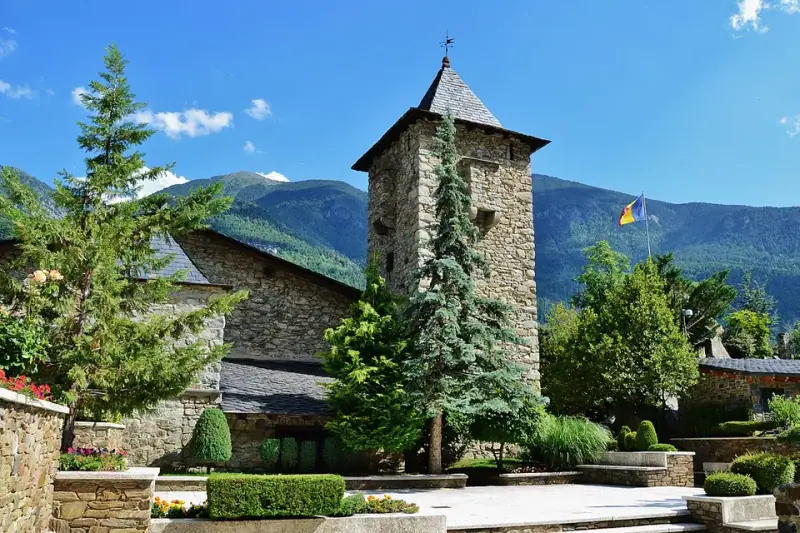
Casa de la Vall
Casa de la Vall gives Andorra’s political history a physical setting rather than reducing it to constitutional dates. The compact stone house served the General Council for centuries, so domestic rooms, ceremonial spaces and institutional functions sit unusually close together. Its scale also helps explain how government developed in a small Pyrenean community. A visit pairs naturally with the old streets around Sant Esteve and offers a useful foundation before exploring parish churches and rural houses elsewhere in the country.
- Duration
- Allow time to explore — check current visitor information.
- Price
- Check current official information.
- Start time
- Choose a start time that suits your day.
- 2
Església de Sant Esteve
Sant Esteve is valuable for reading Andorra’s architectural continuity in one building. The surviving Romanesque apse anchors the church in the medieval period, while later additions show how a parish church changed with the capital around it. Its location beside the historic centre makes it easy to compare religious and civic architecture without a long transfer. The interest is not only the age of individual elements, but the layered fabric created as the community repeatedly adapted an older sacred site.
- Duration
- Allow time to explore — check current visitor information.
- Price
- Check current official information.
- Start time
- Choose a start time that suits your day.
Santa Coloma and medieval valley crossing
Andorra la Vella
- 1
Església de Santa Coloma d’Andorra
Santa Coloma brings together two unusually legible phases of Andorran church building. The simple early nave preserves the character of a pre-Romanesque sanctuary, while the circular bell tower provides a striking later medieval contrast. The site is also important for understanding Andorra’s dispersed mural heritage, because paintings once associated with the church have a complicated modern history. The result is a place where architecture, art history and the changing treatment of medieval heritage can be considered in one compact stop.
- Duration
- Allow time to explore — check current visitor information.
- Price
- Check current official information.
- Start time
- Choose a start time that suits your day.
- 2
Sant Vicenç d’Enclar
Sant Vicenç d’Enclar is significant because the church is only one part of a larger historic landscape. Reaching the site reveals why this rocky position mattered: it overlooks the valley and preserves traces linked to settlement and defence as well as worship. The modest pre-Romanesque architecture contrasts with grander later bell towers elsewhere in Andorra. For travellers interested in how medieval communities used terrain, the combination of archaeology, church and elevated setting is more informative than treating the building as an isolated monument.
- Duration
- Allow time to explore — check current visitor information.
- Price
- Check current official information.
- Start time
- Choose a start time that suits your day.
- 3
Pont de la Margineda
Pont de la Margineda is a clear piece of medieval infrastructure rather than a reconstructed historical display. Its high single arch demonstrates how builders crossed the main valley river with locally available stone and careful geometry. The bridge also adds a practical dimension to Andorra’s heritage: churches and houses show worship and domestic life, while this structure represents movement through the valley. Its riverside setting allows the masonry profile to be appreciated from several angles and makes it a useful stop between the capital and southern parish sites.
- Duration
- Allow time to explore — check current visitor information.
- Price
- Check current official information.
- Start time
- Choose a start time that suits your day.
Southern Romanesque churches
Sant Julià de Lòria
- 1
Sant Serni de Nagol
Sant Serni de Nagol is important because architecture and painting survive together in a small hillside church. Its documented 11th-century consecration places the site early in Andorra’s Romanesque story, while the wall paintings preserve rare evidence of medieval visual culture in their architectural setting. The elevated location above Sant Julià also reinforces the relationship between small religious sites and dispersed settlement. Nagol is therefore a strong southern counterpart to the better-known churches around Canillo and Ordino.
- Duration
- Allow time to explore — check current visitor information.
- Price
- Check current official information.
- Start time
- Choose a start time that suits your day.
- 2
Sant Miquel de Fontaneda
Sant Miquel de Fontaneda is a compact example of the small churches that gave scattered Andorran communities their own religious focal points. The simple nave, apse and bell gable avoid the monumental scale of larger parish churches, making masonry and setting the main subjects. Its southern location also extends a Romanesque itinerary beyond the more frequently visited central and northern valleys. Combined with Nagol and Canòlich, Fontaneda helps present Sant Julià de Lòria as a distinct historic landscape rather than merely an approach to the capital.
- Duration
- Allow time to explore — check current visitor information.
- Price
- Check current official information.
- Start time
- Choose a start time that suits your day.